How to Read a Male Enhancement Supplement Label
| Start here | Read the Supplement Facts panel, not the marketing on the front. |
| Green flags | Named ingredients, printed milligram doses, standardization %, GMP / made-in-USA / third-party testing. |
| Red flags | “Proprietary blend” hiding doses, no standardization, fairy-dusting, disease claims. |
| Golden rule | If you can’t see how much of each ingredient you’re getting, assume it’s not enough. |
Knowing how to read a male enhancement supplement label is the single most valuable skill you can have as a buyer in this category — more useful than any individual ingredient fact. The market is full of products with dazzling front-of-bottle promises and disappointing back-of-bottle reality. The good news: everything you need to judge a product honestly is legally required to be printed on the label. This guide teaches you to read it like an insider, so you stop paying for hype and start buying based on what’s actually in the bottle.
Ignore the front, read the back
The front of a supplement label is marketing. Words like “maximum strength,” “advanced,” “clinical” and “proprietary” are not regulated claims of potency — they’re design choices. The real information lives on the back, in the Supplement Facts panel, which the FDA requires manufacturers to present in a standardized format. Learning to read that one box is 90% of the job. So when you pick up any male-enhancement supplement label, flip it over immediately and start there.
Step 1: Check the serving size
Before you look at any ingredient amount, find the serving size and servings per container. This is the sneakiest place for a label to mislead. A product might list impressive doses — but only if you take four capsules a day, which means a “30-day” bottle of 120 capsules actually lasts 30 days at four-a-day, and the per-capsule dose is a quarter of what the panel headline implies. Always mentally normalise everything to “per daily serving” so you’re comparing products fairly. A once-daily format, like a single gummy, makes this refreshingly simple.
Step 2: Read each active ingredient — name, form and dose
Now go line by line down the active ingredients. For each one, you want three things:
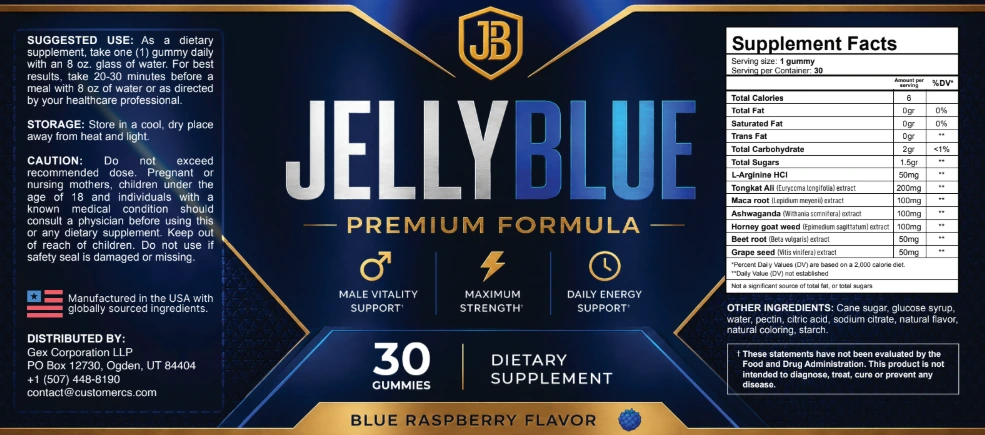
- ✓ The specific name — ideally the botanical name too (e.g. Eurycoma longifolia for Tongkat Ali), so you know exactly what plant it is.
- ✓ The form — root extract vs whole plant, which salt or which amino acid, and any branded/standardized version.
- ✓ The milligram dose — the actual amount per serving, printed as a number.
Then ask the key question: does this dose match what research actually uses? Our ingredient guides give you the reference ranges — for example, Tongkat Ali is typically studied at 200–400 mg of a standardized extract, and ashwagandha at roughly 300–600 mg. If a label lists a great ingredient but at a fraction of the researched amount, that’s “fairy dusting” — adding a token pinch so the name can appear on the front while the effective dose is missing.
A label you can actually read
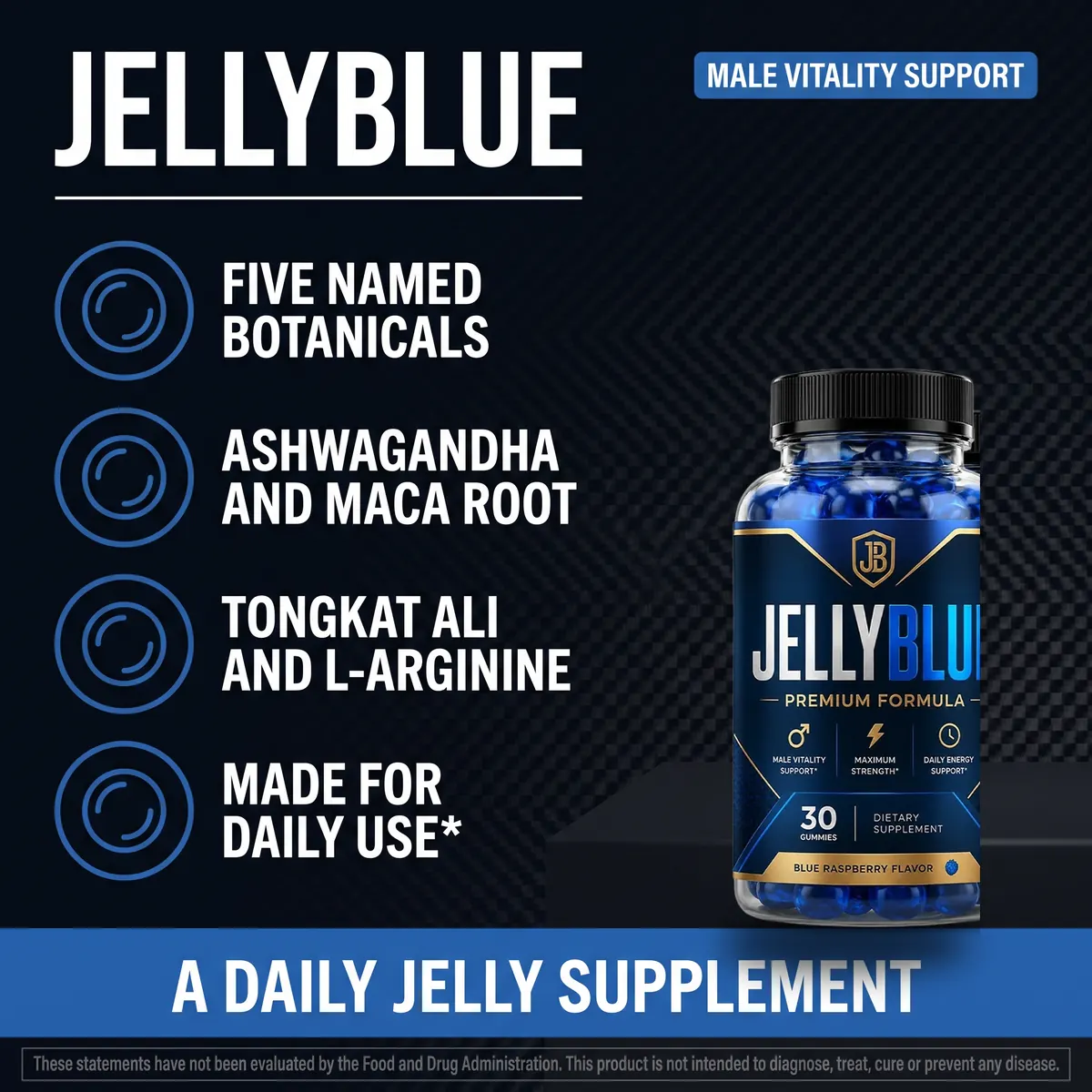
JellyBlue prints all seven actives and their doses on the panel — no hidden blends — delivered as one blue-raspberry gummy a day, backed by a 60-day guarantee.
See JellyBlue PackagesStep 3: Beware the “proprietary blend”
This is the biggest red flag in the entire category. A proprietary blend lists several ingredients together under one combined weight — for example, “Male Vitality Blend 1,200 mg” — without telling you how much of each individual ingredient is inside. It’s legal, and manufacturers justify it as protecting their “secret recipe.” In practice, it’s often used to hide the fact that the blend is mostly a cheap filler ingredient with only trace amounts of the expensive, effective ones.
Here’s the trap: a blend could be 1,150 mg of a cheap ingredient and just 50 mg split among the five botanicals you actually bought it for. You’d never know, because the label doesn’t break it down. The rule is simple: if the individual doses are hidden inside a blend, assume they’re too small to matter. The best products disclose every ingredient’s exact dose separately — that transparency is a sign of a manufacturer with nothing to hide.
Step 4: Look for standardization
For botanical extracts, milligrams alone don’t tell the whole story — standardization does. A standardized extract guarantees a set percentage of the plant’s active compound. You’ll see this written as, for example, “standardized to 10% icariin” for horny goat weed, or “5% withanolides” for ashwagandha. As we explain in our comparison of maca root vs horny goat weed, two extracts with identical milligrams can differ hugely in strength depending on their standardization. A precisely standardized 200 mg extract can easily out-deliver 1,000 mg of vague raw powder. If a botanical is standardized, the label will usually say so proudly.
Step 5: Check the “other ingredients” line
Below the active ingredients sits a small line called Other Ingredients — the binders, fillers, flavours, colours and coatings. This is where you can spot unnecessary additives, artificial colours or allergens (gluten, dairy, soy). It’s also where diet-conscious buyers confirm a product is vegetarian, gluten-free or non-GMO. A short, clean “other ingredients” list is generally a good sign; a long list of hard-to-pronounce additives is worth a second look.
Step 6: Confirm quality and manufacturing signals
Finally, look for signals that the product was made and tested responsibly. None of these prove a supplement “works,” but together they show a manufacturer that takes accuracy seriously:
- ✓ GMP-certified facility — made under Good Manufacturing Practice standards.
- ✓ Made in the USA or another well-regulated jurisdiction.
- ✓ Third-party testing — independent verification of what’s in the bottle.
- ✓ Clear contact details and a satisfaction guarantee — a company that stands behind its product.
Red flag: illegal disease claims
One more thing to watch on any male enhancement supplement label: disease claims. Dietary supplements are not allowed to claim they diagnose, treat, cure or prevent any disease. If a label (or its marketing) promises to “cure” a medical condition or replace a prescription medication, that’s both a legal red flag and a sign of an untrustworthy seller. Legitimate products use general, structure-and-function language and carry the FDA disclaimer — the small print you’ll see at the bottom of this very page.
Putting it all together
Reading a supplement label well takes about sixty seconds once you know the steps: flip to the back, normalise to a daily serving, read each active’s name-form-dose, reject hidden blends, check standardization, scan the other-ingredients line, and confirm the quality signals. Do that and you’ll instantly filter out most of the noise in this category. For the reference doses to compare against, keep our ingredient guides handy — starting with how L-Arginine works and the wider picture in boosting male stamina and energy after 40. Transparency is exactly what a well-built formula like JellyBlue is designed to give you.
Frequently asked questions
How do you read a male enhancement supplement label?
Start with the Supplement Facts panel: check the serving size, then each active ingredient’s name, form and milligram dose. Confirm doses match amounts used in research, look for standardization percentages on extracts, and be wary of proprietary blends that hide individual amounts.
What is a proprietary blend and why does it matter?
A proprietary blend lists several ingredients under one combined weight without disclosing how much of each is included. It matters because a blend can look impressive while containing only tiny, sub-effective amounts of the ingredients you actually want. Transparent labels list each dose separately.
What does standardized extract mean on a label?
A standardized extract guarantees a set percentage of the plant’s active compound, such as icariin in horny goat weed or withanolides in ashwagandha. It tells you the extract’s real strength, which raw milligrams alone cannot.
What certifications should I look for?
Look for signs of quality manufacturing and testing, such as GMP (Good Manufacturing Practice) facilities, made-in-USA sourcing, and third-party testing. These do not prove a product works, but they indicate the maker takes quality and accuracy seriously.
Are more ingredients always better?
No. A long list can mean each ingredient is under-dosed to fit the budget. A shorter list of well-chosen, properly dosed, standardized ingredients is usually more useful than a “kitchen sink” formula stuffed into a hidden blend.
References
1. U.S. Food and Drug Administration — guidance on Supplement Facts labeling and structure/function claims for dietary supplements. 2. Federal Trade Commission — guidance on truthful advertising of supplements. 3. National Institutes of Health, Office of Dietary Supplements — consumer guidance on reading supplement labels and understanding standardized extracts. Links to organizations are for identification and do not imply endorsement of this product.
† These statements have not been evaluated by the FDA. This product is not intended to diagnose, treat, cure or prevent any disease. This article is for general information only and is not medical advice.