JellyBlue Official Website › Blog › L-arginine, horny goat weed and nitrates
Two rows, one pathwayL-Arginine, Horny Goat Weed and Nitrates: Interaction Cautions Worth Knowing
Two rows on the JellyBlue panel touch the same signalling pathway that prescription nitrates and PDE5-inhibitor medicines also work on: L-arginine HCl at 50 mg and horny goat weed extract at 100 mg.
Neither row is anywhere near a drug dose, and the label makes no drug-like claim. The overlap still matters for one group specifically: anyone already prescribed a nitrate for chest pain, an alpha-blocker, or a PDE5-inhibitor tablet for erectile dysfunction, where combining pathways, not just combining doses, is the established caution.
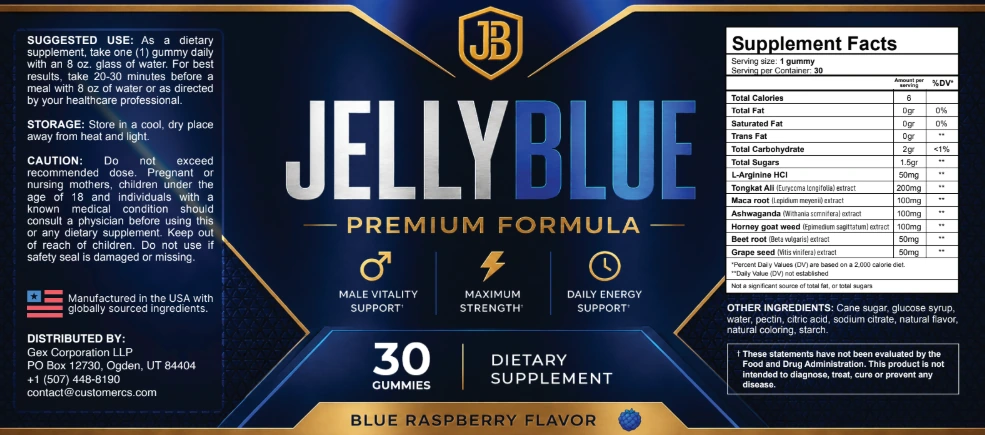
- L-arginine HCl, 50 mg. Trial doses shown to lower blood pressure start around 4 g a day, roughly eighty times the label’s amount.
- Horny goat weed extract, 100 mg. Its marker compound, icariin, is described in one review as the most potent PDE5-inhibiting compound yet found in a natural source, though laboratory testing puts it roughly eighty-fold weaker than sildenafil, and the label prints no icariin figure.
- Nitrates and PDE5-inhibitor drugs do not mix. Combining them is a standing drug-label contraindication because together they can drop blood pressure sharply.
- The herbal market has a documented adulteration problem. A 2022 survey found real PDE5 drugs, undeclared, in a meaningful share of tested sexual-enhancement supplements. That is a market finding, not a finding about JellyBlue.
- The caution is about pathways, not doses. Anyone on nitrates, an alpha-blocker or a PDE5 prescription should read the label and ask a clinician before adding either row to a daily routine.
Two rows on the same pathway
JellyBlue’s Supplement Facts panel lists seven actives, and two of them, on paper, belong to the same physiological story. L-arginine HCl, 50 mg, is an amino acid the body uses to make nitric oxide, the same signalling molecule that widens blood vessels. Horny goat weed extract, 100 mg (Epimedium sagittatum), carries icariin, a flavonoid studied for its ability to block an enzyme called phosphodiesterase-5, or PDE5, the same enzyme every prescription erectile-dysfunction tablet on the market is built to block.
Neither fact makes JellyBlue a drug, and its own label claims stop at male vitality support, maximum strength and daily energy support. But the two rows sit on either side of the same pathway that nitric oxide and PDE5 govern, and that pathway is exactly where prescription nitrates and prescription PDE5 inhibitors are already known to interact dangerously with each other. This post follows both rows through the research on that pathway, at the amounts actually printed on the panel.
L-arginine: the dose gap
L-arginine is the raw material the body’s nitric oxide synthase enzymes use to build nitric oxide, and supplement trials have tested whether adding more of it lowers blood pressure. A 2011 meta-analysis pooled 11 randomised, placebo-controlled trials with 387 participants, using doses of 4 to 24 g a day, and found L-arginine lowered systolic blood pressure by 5.39 mmHg and diastolic blood pressure by 2.66 mmHg on average.
A 2022 dose-response meta-analysis of 22 trials found a similar pattern, a weighted mean drop of 6.40 mmHg systolic and 2.64 mmHg diastolic, and reported that an effective dose became detectable starting around 4 g a day.
JellyBlue’s panel prints 50 mg of L-arginine HCl, which is not even 50 mg of free arginine once the hydrochloride salt’s added weight is accounted for. Against a 4 g a day threshold, that is roughly eighty times less than the smallest amount either meta-analysis found effective. On the numbers alone, the row is not positioned to reproduce a measurable blood-pressure effect by itself.
| Source | Trials | Daily dose tested | Systolic change |
|---|---|---|---|
| 2011 meta-analysis | 11, 387 participants | 4–24 g | −5.39 mmHg |
| 2022 meta-analysis | 22 trials | ≥4 g effective | −6.40 mmHg |
| JellyBlue panel | — | 0.05 g (50 mg) | Not tested at this dose |
Figures from each meta-analysis’s abstract. Neither pooled trial tested JellyBlue.
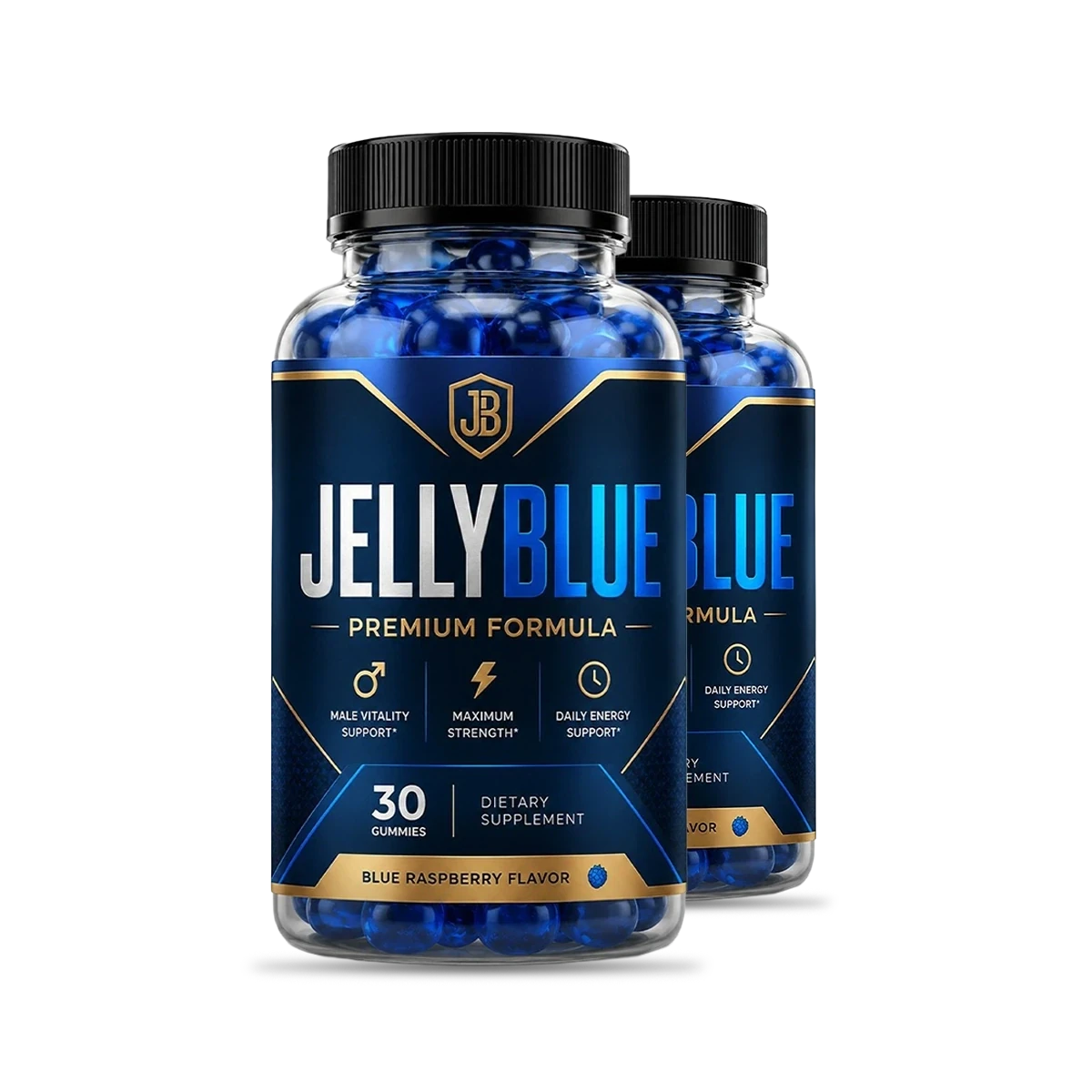
JellyBlue: Seven Actives, Every Amount Printed
L-arginine HCl and horny goat weed extract are two of seven named actives, 650 mg in all, with no proprietary blend.
Order JellyBlueOne gummy a day · 30 to a bottle
Horny goat weed: what icariin does in a test tube
Horny goat weed’s research case runs on icariin, and the enzyme it is studied against is PDE5, the target of sildenafil, tadalafil and vardenafil. A 2021 review of 97 medicinal plants screened for PDE5-inhibiting activity singled out icariin and a related compound, icariside II, both isolated from Epimedium brevicornum, as, in the authors’ words, the most effective PDE5 inhibitor yet identified from a natural source. The same review lists a handful of other plants with measurable PDE5 activity, Ginkgo biloba, Kaempferia parviflora and Vitis vinifera, the source of the grape seed extract on JellyBlue’s own panel, among them.
“Most effective from a natural source” still leaves a wide gap to a pharmaceutical. A 2008 laboratory study measured icariin’s own potency directly against PDE5A1 and found an IC50 of 5.9 micromolar, a measure of how much compound it takes to block half the enzyme’s activity; lower means more potent. Sildenafil’s IC50 in the same kind of assay runs around 74 nanomolar, roughly 80 times lower, meaning icariin itself is roughly 80-fold weaker than sildenafil at blocking the same enzyme in a test tube. The same paper went on to modify icariin chemically and produced a derivative compound with an IC50 of 75 nanomolar, essentially matching sildenafil’s potency, but that modified compound is a laboratory tool, not something present in a horny goat weed extract or on any supplement label.
None of this is a test of JellyBlue. It is laboratory pharmacology on isolated icariin and a modified relative of it, not a clinical trial and not a measurement of the 100 mg horny goat weed row on the panel, which does not print an icariin content at all. The honest reading is that the ingredient touches the right enzyme, weakly, in a dish, and the panel does not say by how much.
Why nitrates and PDE5 drugs do not mix
This is the part of the pathway with the clearest, most established evidence, and it concerns prescription drugs rather than supplements. A 2005 pharmacology review states plainly that PDE5 inhibitors are contraindicated in patients receiving organic nitrates, because the two act on the same nitric-oxide signalling cascade from different ends and together can drop blood pressure sharply and unpredictably. The interaction is dose- and drug-dependent: with sildenafil or vardenafil the window of concern with nitroglycerin was no longer measurable by 24 hours, while tadalafil, with a longer half-life, carries a longer window. The same review notes that PDE5 inhibitors combined with an alpha-blocker, a class of blood-pressure medicine, can also cause orthostatic hypotension, a sudden drop in blood pressure on standing, a risk that eases somewhat with long-term alpha-blocker use.
That contraindication is specifically about prescription-strength PDE5 inhibitors and prescription nitrates, at pharmaceutical doses, not about a supplement carrying 100 mg of a botanical extract. The laboratory numbers above suggest icariin itself is a weak PDE5 inhibitor at typical extract strengths, nowhere near a drug dose. The reason the contraindication is still worth stating here is simple: it establishes that stacking anything that pushes on this same pathway, however weakly, from a direction someone on nitrates or an alpha-blocker is not expecting, is the kind of thing a clinician should know about and weigh, rather than something to work out from a supplement label alone.
What a 2022 supplement survey found
There is a second, separate reason this pathway deserves care, and it has nothing to do with JellyBlue’s own ingredient list. A 2022 survey tested 40 herbal supplements marketed for sexual enhancement and found significant, undeclared amounts of actual PDE5-inhibitor drugs in a meaningful share of them: sildenafil in 10 of the 40, tadalafil in 1 and vardenafil in 2, with some samples carrying an estimated daily intake above 100 mg of sildenafil-equivalent, several times a typical 50 or 100 mg prescription dose.
That survey did not test JellyBlue and says nothing about this product specifically; the panel here lists seven named actives with no undeclared ingredients claimed or implied. It is included because the underlying risk it documents, real prescription PDE5 drugs turning up, unlabelled, in products marketed as herbal, is exactly the scenario the nitrate contraindication above is built to prevent, and it is a reason the category as a whole, not any one brand, deserves a cautious approach from anyone already on a nitrate or a PDE5 prescription.
Who should read this label twice
JellyBlue’s own caution line already asks anyone with a known medical condition to consult a physician before use, and this pathway is a concrete reason that line matters for a specific group. Three situations are worth a conversation with a clinician before adding this or any similar formula to a daily routine: a current prescription for a nitrate, most often for angina or chest pain; a current prescription for a PDE5 inhibitor such as sildenafil, tadalafil or vardenafil; and treatment with an alpha-blocker for blood pressure or an enlarged prostate.
Outside those three situations, the pharmacology above still describes small, largely theoretical overlaps rather than an established risk at the printed amounts: 50 mg of L-arginine HCl is far below the doses shown to move blood pressure in trials, and the panel’s 100 mg of horny goat weed extract carries no stated icariin content to weigh against the weak in-vitro potency measured for the isolated compound. The purpose of laying the pathway out is not to suggest JellyBlue behaves like a drug; it is to give the three groups above a specific, sourced reason to ask before they start, rather than to find out after.
Questions about these two rows
Does JellyBlue act like a PDE5-inhibitor drug?
No. Its label makes no such claim, and the laboratory evidence on icariin itself puts it roughly eighty times weaker than sildenafil at the same target enzyme, with no icariin amount printed on the panel to weigh that gap against.
Is 50 mg of L-arginine HCl enough to affect blood pressure?
The trials that found a blood-pressure effect used 4 to 24 g a day, roughly eighty times the panel’s 50 mg row. At that gap, the row is not positioned to reproduce those results on its own.
Can I take JellyBlue with my nitrate or ED prescription?
This post is not medical advice and cannot answer that for an individual. Because both rows touch the same nitric-oxide and PDE5 pathway that nitrates and PDE5-inhibitor drugs already interact on, anyone in either situation should ask a prescribing clinician first.
Did the 2022 supplement survey test JellyBlue?
No. It tested 40 other herbal sexual-enhancement products and found undeclared PDE5 drugs in several of them. It is cited here as evidence of a category-wide risk, not as a finding about this product.
Why does grape seed extract come up in this post?
The same 2021 review that ranks icariin as the strongest natural PDE5 inhibitor also lists Vitis vinifera, the source of JellyBlue’s grape seed extract row, among plants with measurable PDE5-related activity. Its dose and evidence are covered separately on the L-arginine and grape seed post.
JellyBlue is a dietary supplement, not a treatment for erectile dysfunction, low blood pressure control or any heart condition. Anyone taking a nitrate, an alpha-blocker or a PDE5-inhibitor prescription should talk to the prescribing clinician before adding this or any similar supplement.
Sources cited in this post
- Dong JY, Qin LQ, Zhang Z, et al. Effect of oral L-arginine supplementation on blood pressure: a meta-analysis of randomized, double-blind, placebo-controlled trials. Am Heart J. 2011;162(6):959-965. PMID 22137067. https://pubmed.ncbi.nlm.nih.gov/22137067/
- Shiraseb F, Asbaghi O, Bagheri R, et al. Effect of l-Arginine Supplementation on Blood Pressure in Adults: A Systematic Review and Dose-Response Meta-analysis of Randomized Clinical Trials. Adv Nutr. 2022;13(4):1226-1242. PMID 34967840. https://pubmed.ncbi.nlm.nih.gov/34967840/
- Dell’Agli M, Galli GV, Dal Cero E, et al. Potent inhibition of human phosphodiesterase-5 by icariin derivatives. J Nat Prod. 2008;71(9):1513-1517. PMID 18778098. https://pubmed.ncbi.nlm.nih.gov/18778098/
- Anand Ganapathy A, Hari Priya VM, Kumaran A. Medicinal plants as a potential source of Phosphodiesterase-5 inhibitors: A review. J Ethnopharmacol. 2021;267:113536. PMID 33137431. https://pubmed.ncbi.nlm.nih.gov/33137431/
- Akuamoa F, Bovee TFH, van Dam R, et al. Identification of phosphodiesterase type-5 (PDE-5) inhibitors in herbal supplements using a tiered approach and associated consumer risk. Food Addit Contam Part A. 2022;39(6):1021-1032. PMID 35323088. https://pubmed.ncbi.nlm.nih.gov/35323088/
- Kloner RA. Pharmacology and drug interaction effects of the phosphodiesterase 5 inhibitors: focus on alpha-blocker interactions. Am J Cardiol. 2005;96(12B):42M-46M. PMID 16387566. https://pubmed.ncbi.nlm.nih.gov/16387566/