JellyBlue Official Website › Blog › Maca root at 100 mg
The maca rowMaca Root Dosage in Jelly Blue: 100 mg Against the Trials
Maca root dosage in Jelly Blue is 100 mg of extract per gummy, one of seven actives with its own printed amount. The twelve-week desire trial used amounts fifteen to thirty times higher, so the post reads that gap carefully and reports what the four-trial review concluded about maca.
The trial behind maca’s best-known finding gave healthy men 1,500 or 3,000 mg a day for twelve weeks; self-reported desire improved from week eight while testosterone did not move. This post sets the row beside that trial and a four-trial review.
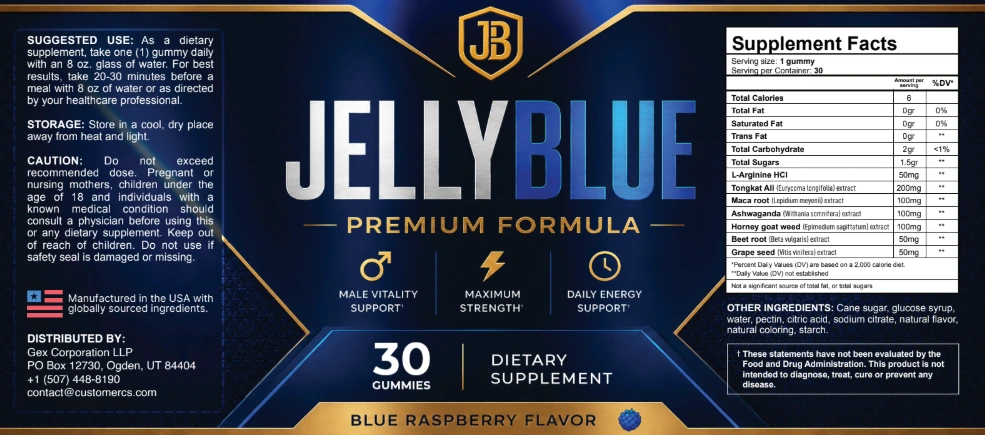
- 100 mg a gummy. Maca root extract (Lepidium meyenii) is the third row on the JellyBlue panel and one of three rows at 100 mg.
- 1,500 or 3,000 mg a day. The two doses in the twelve-week trial of healthy men, fifteen and thirty times the row.
- Week eight. The first point at which that trial saw self-reported desire change; testosterone and oestradiol did not move.
- Limited evidence. The verdict of a systematic search that found four randomised trials, too few and too small for firm conclusions.
The maca row on the JellyBlue panel
Turn a JellyBlue bottle round and the Supplement Facts panel lists seven actives, each with its own milligram figure. Maca root extract sits third, after L-arginine and tongkat ali, printed as 100 mg with its Latin name, Lepidium meyenii. It shares that figure with ashwagandha and horny goat weed, and the three rows together make up 300 of the 650 mg of actives in every gummy.
Maca is an Andean plant of the brassica, or mustard, family, grown for its root. The systematic review of maca describes it that way before it turns to the trials. It is sold as a powder, as a heat-processed flour and as extracts, and those forms are not interchangeable milligram for milligram.
The row also tells you something by what it names. The federal panel rule, 21 CFR 101.36, asks that a botanical on a supplement label say which part of the plant it comes from, and this row does: root. The same rule says that for an extract with its solvent removed, the weight printed is the weight of the dried extract. So 100 mg means 100 mg of maca root extract, not 100 mg of fresh or dried root.
What the twelve-week desire trial gave
The study most often behind maca’s reputation is a double-blind, placebo-controlled trial from Lima, published in 2002. It randomised men aged 21 to 56 to one of three arms for twelve weeks: 1,500 mg of gelatinised maca a day, 3,000 mg a day, or a placebo. At weeks four, eight and twelve the researchers recorded each man’s own rating of his sexual desire, the Hamilton scales for depression and anxiety, and blood levels of testosterone and oestradiol.
Desire improved with maca from week eight. Testosterone and oestradiol did not differ from placebo at any point, and the mood scores did not explain the change either. That separation was the authors’ point: whatever maca was doing in this trial, it was not doing it by raising hormone levels.
| What the trial did | Detail | The JellyBlue gummy |
|---|---|---|
| Who took part | Healthy men aged 21 to 56 | Sold to adult men |
| Form | Gelatinised maca | Maca root extract |
| Daily amount | 1,500 mg or 3,000 mg | 100 mg in one gummy |
| Length | 12 weeks | One bottle is 30 days |
| First change in desire | Week 8 | Week 8 is day 56 of taking it |
| Testosterone | No change against placebo | No hormone claim on the label |
Trial details from the abstract of the 2002 study, which tested maca on its own rather than any finished product.
Fifteen times and thirty times: reading the gap
Set the row beside the trial and the arithmetic is short. The smaller trial dose, 1,500 mg, is fifteen times the 100 mg in a JellyBlue gummy; the larger, 3,000 mg, is thirty times. A buyer would need fifteen gummies a day to reach the lower arm, which the label rules out in its first words: do not exceed recommended dose.
There is one honest complication. The trial used gelatinised maca, a processed flour of the whole root, while the panel lists an extract, and an extract can be concentrated so that one milligram stands for several milligrams of root. No ratio is printed for this row, so no conversion can be made in either direction. The fair reading is the plain one: 100 mg of extract against 1,500 mg of processed root.
Why carry maca at a fraction of its trial dose? Because a gummy is small. Each JellyBlue gummy holds 650 mg of actives alongside cane sugar, glucose syrup, pectin and water, and the formula spreads that across seven ingredients rather than spending it on one. Maca here is one of seven named amounts, not a single-ingredient maca supplement, and that is the frame in which to judge it.
NCCIH’s guidance on using supplements wisely makes the general point: supplements bought in shops or online can differ in important ways from the products tested in studies. A printed amount is what lets you measure that difference yourself.
What the four-trial review concluded
One trial is one trial. In 2010 a team including Edzard Ernst searched seventeen databases for every randomised trial comparing maca with a placebo for sexual function, and found four that met its criteria. The resulting systematic review is still the clearest summary of the human evidence.
Two of the four suggested a positive effect: one on sexual dysfunction in healthy menopausal women, and one on sexual desire in healthy adult men. A third, in men with erectile difficulty, reported significant effects on the five-item IIEF-5 questionnaire. The fourth, in healthy cyclists, found no effect.
The review’s verdict is the phrase to remember: limited evidence. The number of trials, their combined size and their average quality were all too small for firm conclusions, and the authors asked for more rigorous studies.
Two positive trials
Desire or function improved in healthy menopausal women and in healthy adult men.
One positive on the IIEF-5
A trial in men with erectile difficulty reported significant effects on the questionnaire.
One with no effect
Healthy cyclists given maca showed no change against placebo.
The verdict
Limited evidence: too few trials, too small, of limited quality.
JellyBlue: every amount printed, maca included
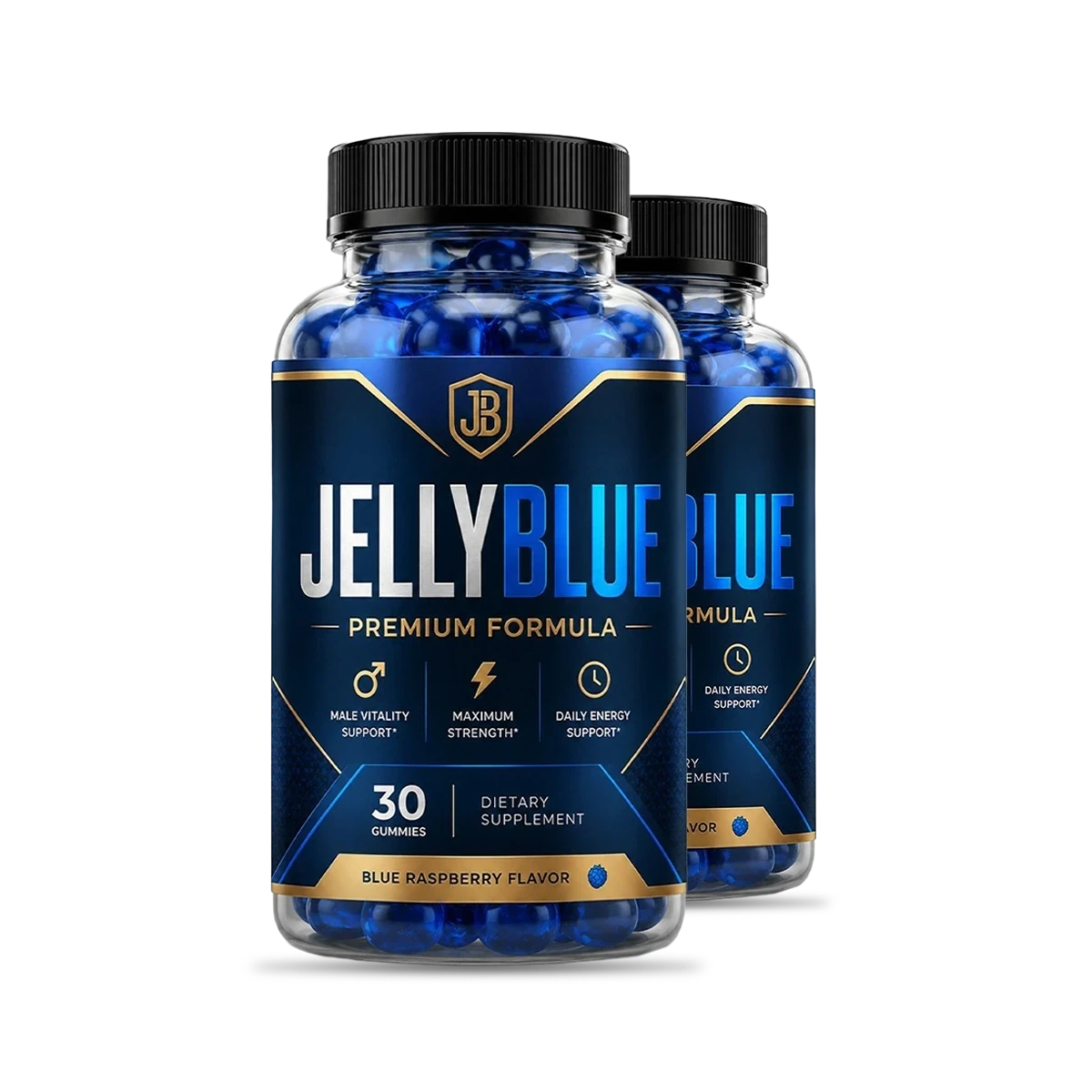
One blue-raspberry gummy a day with seven actives and seven milligram figures, maca root extract at 100 mg among them. Order through the official website and the refund window starts on the day you pay.
Two, three or six bottles · free US shipping on three and six · 60 days from the day you pay
Order JellyBlue On The Official WebsiteOne gummy a day · 30 to a bottle · lot JEL-26/GO-5083
Where maca sits among herbal supplements
The widest view comes from a 2018 meta-analysis of herbal supplements tested in men with erectile difficulty. It gathered 24 randomised trials and 2,080 men. Twelve of the trials tested a single herb: five on ginseng, three on saffron, two on tribulus, one on pine bark and one on maca, with 50 men.
Ginseng was the only single herb with a significant pooled effect on erectile function scores. Maca and pine bark showed what the authors called very preliminary positive results, a fair description of one trial of fifty men. Adverse events were recorded in 19 of the 24 trials, with no significant difference between the herbs and placebo.
| Single herb | Trials | Men | What the meta-analysis found |
|---|---|---|---|
| Ginseng | 5 | 399 | A significant improvement in erectile function scores |
| Saffron | 3 | 397 | Mixed results |
| Tribulus | 2 | 202 | Mixed results |
| Pine bark | 1 | 21 | Very preliminary positive results |
| Maca | 1 | 50 | Very preliminary positive results |
From the 2018 meta-analysis in Drugs. Ginseng is not in the JellyBlue formula; maca is.
None of this makes maca a treatment, and the label does not present it as one. It places maca where the evidence places it: an ingredient with a small, encouraging and unconfirmed human record, studied mostly at doses many times larger than a gummy carries.
What a six-bottle buyer can fairly expect by week eight
Week eight is the number from the trial worth carrying home. It was the first point at which desire changed on 1,500 or 3,000 mg a day, and it says something about the pace of maca even at a much smaller amount. Anyone judging a daily supplement in its first fortnight is judging it early.
It also lines up with the refund window in a way worth planning for. The JellyBlue window runs 60 days from the purchase date, not from the first gummy. Allow a few days for delivery and week eight of taking it falls close to the day the window closes. On a six-bottle order, about four bottles are still sealed at that point.
- Day 0
You pay
The 60-day window starts on the purchase date. The parcel ships from the US.
- Weeks 1-3
The routine
One gummy a day with an 8 oz glass of water, 20 to 30 minutes before a meal, as the label directs.
- Weeks 3-6
The usual wait here
Buyers on this website most often describe a wait of 3-6 weeks, day 21 to day 42.
- Week 8
The trial’s first change
Day 56 of taking it. In the desire trial, at fifteen to thirty times this amount, this is where the change began.
- Day 60
The refund window shuts
Counted from purchase. On six bottles about four are still sealed, so decide here, not at day 180.
The fair expectation is modest and specific: a steady routine for eight weeks, a decision made with the window still open, and a judgment based on how you feel rather than on a promise the label never makes. The results timeline and pricing page set the packs against those dates.
Questions about the maca row
Is 100 mg of maca enough to matter?
It is well below the 1,500 and 3,000 mg a day used in the twelve-week desire trial, and no trial cited here tested 100 mg of maca extract. In JellyBlue it is one of seven named actives; the lead row is tongkat ali at 200 mg.
Does maca raise testosterone?
Not in the trial that made its name: serum testosterone and oestradiol did not differ from placebo over twelve weeks. JellyBlue makes no hormone claim for any row.
What is gelatinised maca?
A heat-processed flour of the root, and the form used in the desire trial. The JellyBlue panel lists a maca root extract, which is a different preparation.
Where is maca on the seller’s artwork?
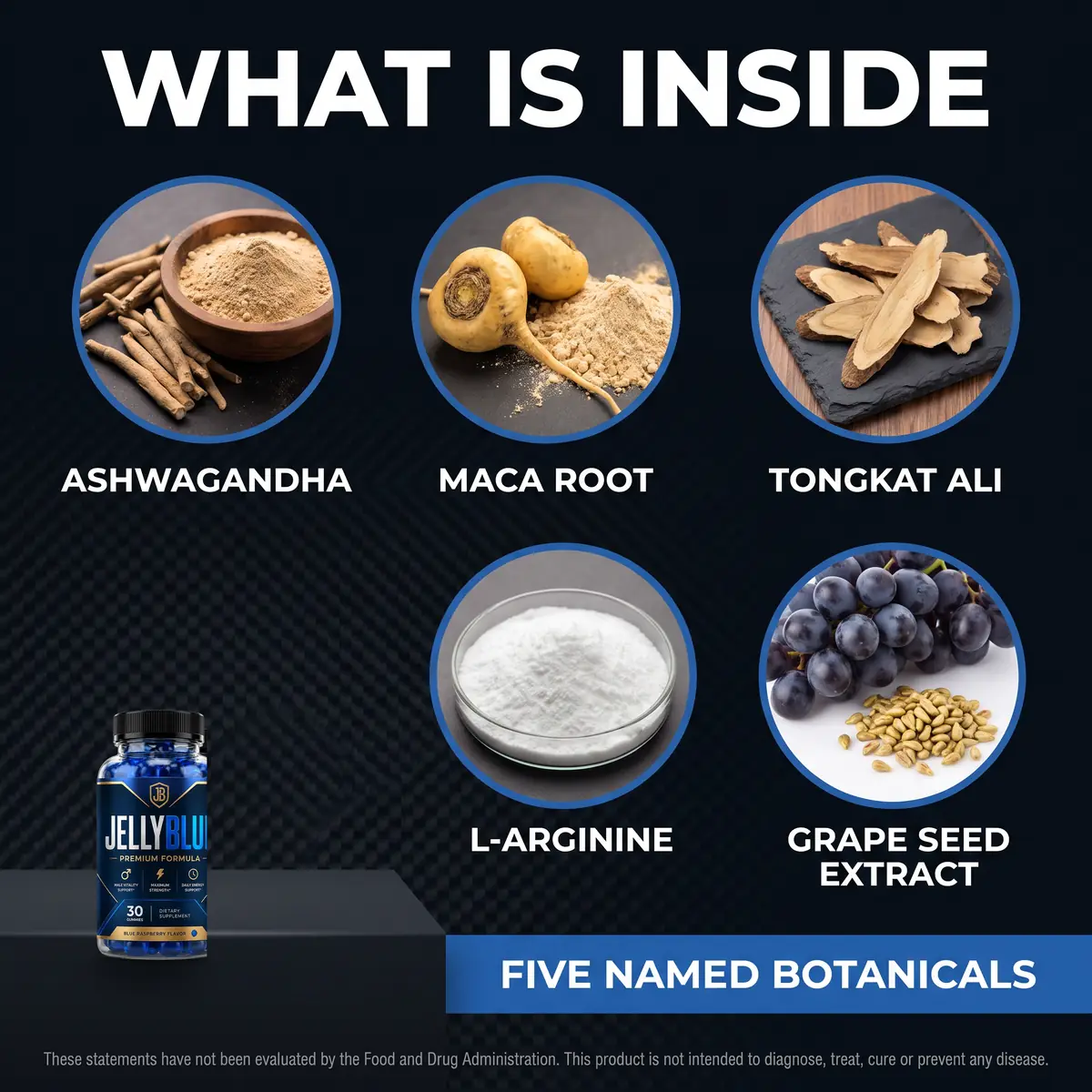
It is one of the five circles on the WHAT IS INSIDE graphic and one of the six tiles on the INSIDE JELLYBLUE graphic. The panel is the document that gives its amount.
How much maca root is in Jelly Blue?
One gummy holds 100 mg of maca root extract, printed as its own row on the panel among seven actives. The label directs one gummy a day and says not to exceed it.
How long did the trials behind Jelly Blue maca run?
The twelve-week desire trial is the main one discussed, and it used amounts well above 100 mg. The post explains the gap and what the four-trial review concluded.
JellyBlue is a dietary supplement. It is not a treatment for erectile dysfunction, low testosterone or any other condition, and nothing in this post describes it as one. A lasting change in energy, desire or sexual function can have medical causes, heart disease and diabetes among them, that no supplement addresses, and it deserves a clinician’s assessment.
Sources cited in this post
- Gonzales GF, Córdova A, Vega K, et al, Effect of Lepidium meyenii (MACA) on sexual desire and its absent relationship with serum testosterone levels in adult healthy men, Andrologia, 2002;34(6):367-72, (PubMed record 12472620) https://pubmed.ncbi.nlm.nih.gov/12472620/
- Shin BC, Lee MS, Yang EJ, et al, Maca (L. meyenii) for improving sexual function: a systematic review, BMC Complement Altern Med, 2010;10:44, (PubMed record 20691074) https://pubmed.ncbi.nlm.nih.gov/20691074/
- Borrelli F, Colalto C, Delfino DV, et al, Herbal Dietary Supplements for Erectile Dysfunction: A Systematic Review and Meta-Analysis, Drugs, 2018;78(6):643-673, (PubMed record 29633089) https://pubmed.ncbi.nlm.nih.gov/29633089/
- Using Dietary Supplements Wisely, National Center for Complementary and Integrative Health, National Institutes of Health, https://www.nccih.nih.gov/health/using-dietary-supplements-wisely
- 21 CFR 101.36, Nutrition labeling of dietary supplements, Electronic Code of Federal Regulations, Office of the Federal Register, https://www.ecfr.gov/current/title-21/chapter-I/subchapter-B/part-101/subpart-F/section-101.36