JellyBlue Official Website › Blog › The other ingredients line
The rest of the panelBeyond the Seven Actives: Reading the Other Ingredients Line on the JellyBlue Label
Under JellyBlue’s seven named actives, the panel prints one more line: cane sugar, glucose syrup, water, pectin, citric acid, sodium citrate, natural flavor, natural coloring and starch.
Every ingredient post on this blog follows a milligram figure. This one follows nine words that carry no milligram figure at all, because federal rule does not require one for this part of the label, and explains what each word is doing, what order they appear in and why, and what the legal terms natural flavor and natural coloring do and do not tell a reader.
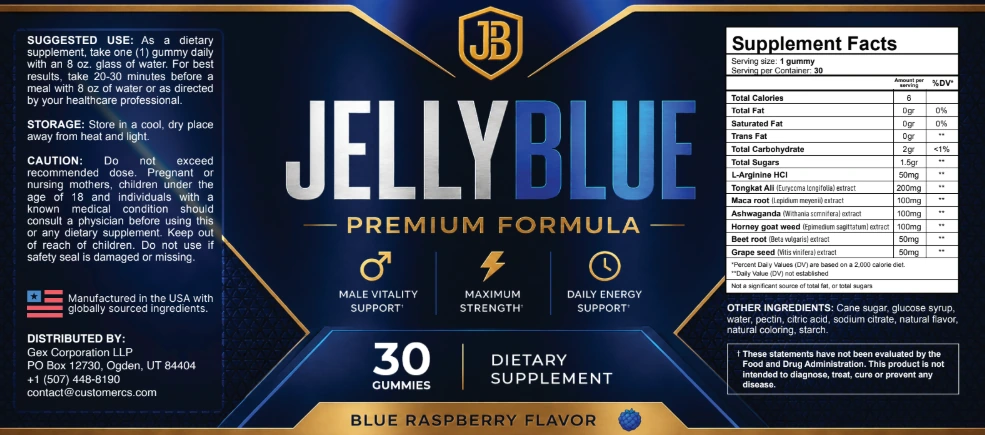
- Nine words, no milligrams. Cane sugar, glucose syrup, water, pectin, citric acid, sodium citrate, natural flavor, natural coloring and starch, in that printed order.
- The order is not random. Federal rule requires ingredients listed in descending order of predominance by weight, with a carve-out for anything under 2% of the product.
- “Natural flavor” is a legal category, not a specific ingredient. The rule that defines it covers a wide range of plant, animal and fermentation sources without requiring the label to name which one.
- Pectin, not gelatin. The gelling choice is why the product carries a vegetarian claim and why the gummy needs citric acid and sodium citrate to set and taste right.
- A 2023 review found food-additive hypersensitivity affects an estimated 1.2% of children studied, driven mostly by artificial colors, sweeteners and preservatives, categories this label’s own choices largely sit outside of.
Seven actives, nine more words
Most of this blog reads the seven active rows on the JellyBlue Supplement Facts panel: tongkat ali, maca, ashwagandha, horny goat weed, L-arginine HCl, beet root and grape seed, each with its own milligram figure. Underneath those seven rows, on the same printed panel, sits a line the earlier posts do not cover: the other-ingredients line, which reads, in full, cane sugar, glucose syrup, water, pectin, citric acid, sodium citrate, natural flavor, natural coloring and starch.
Nothing on that line carries a milligram figure, and nothing has to. It exists for a different reason than the actives list: it tells a reader what the gummy is made of beyond the ingredients meant to do something, the base that carries them, sets their shape and gives the product its blue-raspberry taste. Reading it well means knowing three things: the order it is printed in, what each word legally covers, and what it does and does not disclose.
What each word on the line is doing
Taken one at a time, the nine words split into a few clear jobs. Cane sugar and glucose syrup supply sweetness and bulk; together with the actives they account for the panel’s 6 calories, 2 g of carbohydrate and 1.5 g of total sugars a gummy. Water is the base the other ingredients dissolve and disperse in before the mixture sets. Pectin, a fibre extracted from fruit, is the gelling agent, the reason the gummy holds its chewable shape; it stands in for gelatin, which is derived from animal collagen, and its use is why the product carries a vegetarian claim elsewhere on the site.
Citric acid does two jobs at once: it is the sharp, tart note behind the blue-raspberry flavour, and pectin needs an acidic environment to set properly, so citric acid also supports the gel itself. Sodium citrate works alongside it as a buffer, moderating how acidic the mixture becomes so the set is consistent and the taste is not overwhelmingly sour. Natural flavor supplies the blue-raspberry taste named on the front of the bottle, and natural coloring supplies its blue color; both are defined legal terms, covered in the next section, rather than named ingredients. Starch, printed last, most often plays a small, finishing role in a gummy formulation, commonly a dusting or anti-stick function during moulding and packaging, though the label does not specify which.
Why the order is not random
Food and supplement labels do not list ingredients alphabetically or by importance to the marketer. Federal rule requires them listed by common or usual name in descending order of predominance by weight, from most to least, with one carve-out: ingredients that make up 2 percent or less of the product can be grouped at the end, after a phrase such as contains 2 percent or less of, without needing to hold to strict weight order among themselves.
Read against that rule, JellyBlue’s other-ingredients line is telling a reader something concrete. Cane sugar, first on the list, is present in the greatest amount by weight of anything on that line; glucose syrup and water follow, then pectin, then the smaller-weight ingredients: citric acid, sodium citrate, natural flavor, natural coloring and starch, roughly in decreasing amounts, several of which likely fall under that 2 percent carve-out given how little a flavor, color or buffering agent typically takes to do its job in a product this size.
None of that changes what is in the gummy. It does mean the order itself is information: it is a rough, legally required map of proportion, printed without a single milligram number attached to it.
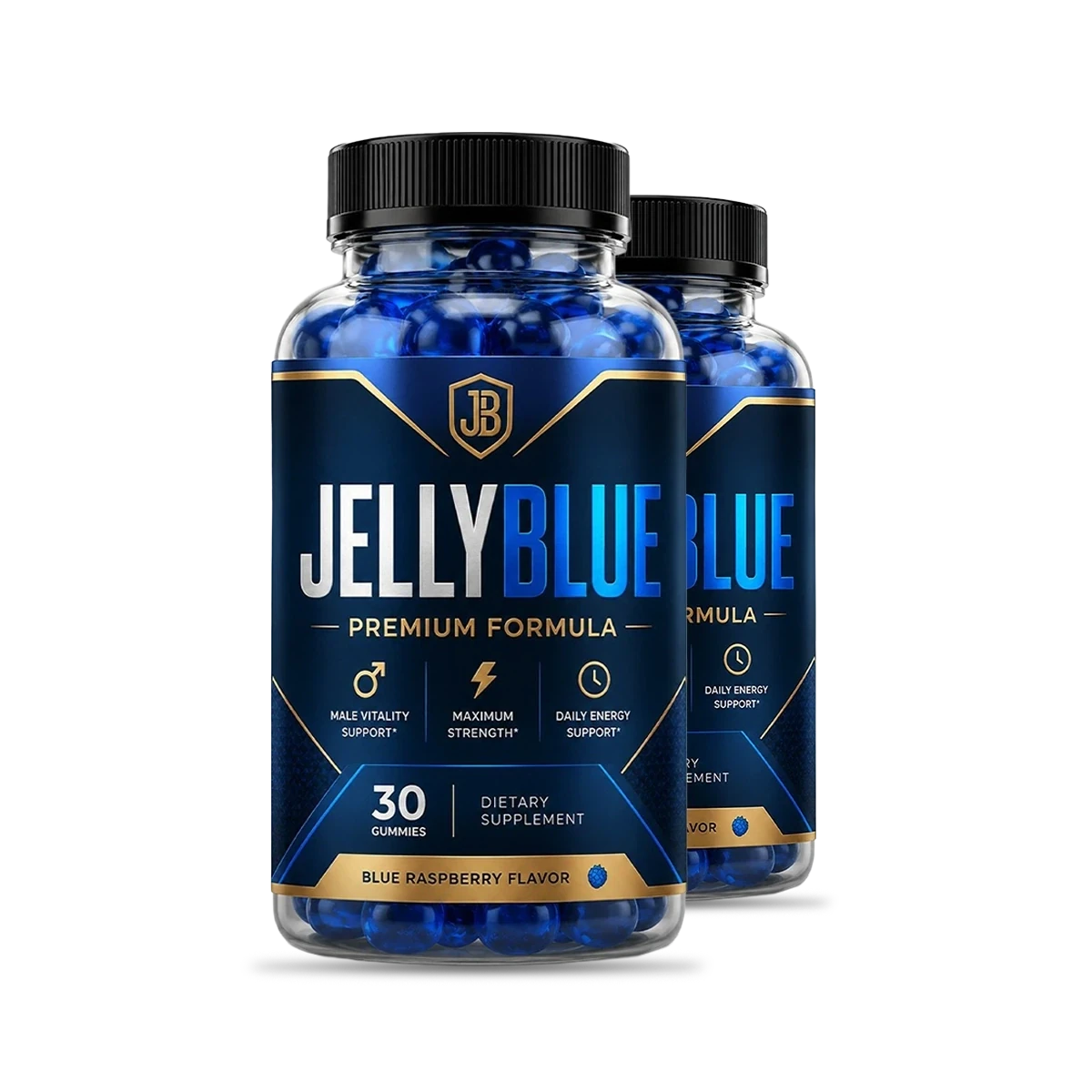
JellyBlue: Seven Actives, Every Amount Printed
Seven named actives, 650 mg in all, with no proprietary blend, and a plainly printed other-ingredients line underneath.
Order JellyBlueOne gummy a day · 30 to a bottle
What “natural flavor” and “natural coloring” legally mean
Of the nine words on the line, natural flavor is the one with the most precise federal definition, and the definition is broader than most readers expect. Federal rule defines natural flavor or natural flavoring as the essential oil, oleoresin, essence or extractive, protein hydrolysate, distillate, or any product of roasting, heating or enzymolysis, which contains the flavoring constituents derived from a spice, fruit or fruit juice, vegetable or vegetable juice, edible yeast, herb, bark, bud, root, leaf or similar plant material, meat, seafood, poultry, eggs, dairy products, or fermentation products of these, whose significant function in food is flavoring rather than nutrition.
That single legal category covers a very wide range of possible source materials, processed in a very wide range of ways, and the rule does not require a label to name which specific source or process was used, only that the resulting substance functions as flavoring rather than nutrition and was drawn from a natural rather than a synthetic source. Natural coloring works on a comparable logic, permitted as a general term for a color additive drawn from a natural source without the label being required to name the specific pigment.
The practical upshot: natural flavor and natural coloring on JellyBlue’s line are accurate, compliant label language, and neither one identifies a specific compound. A reader who wants to know exactly what supplies the blue-raspberry taste or the blue color cannot get that answer from the label alone; the terms are legally sufficient without being that specific.
Why a gummy’s base is a quality question too
It is easy to treat sugar, water and pectin as filler beside seven named actives, but the gummy format has its own, separate quality science, and it is still being formalised. A 2024 study characterised six non-medicinal gummy brands to propose reference quality parameters for the format, since gummies do not yet have the kind of official compendial standard that tablets and capsules have long had. The parameters it measured included adhesiveness (0.009 to 0.028 millijoules), chewiness (2.780 to 6.753 newtons), moisture content under 5 percent, weight uniformity within 2.5 g and a 7.5 percent deviation, and an intraoral dissolution pH between 3.5 and 6.8.
Every one of those measurements depends directly on the other-ingredients line: sugar and glucose syrup content shape texture and moisture retention, pectin concentration and the acidity set by citric acid and sodium citrate govern how the gummy sets and dissolves, and water content determines chewiness and shelf stability. None of this is a claim that JellyBlue was tested in that study, which examined six other brands; it is included because it shows the other-ingredients line is not incidental to product quality. It is the working chemistry the seven actives are suspended in, and it is measurable, even without a milligram figure printed beside any one item on the line.
Sugar, sensitivities and reading for yourself
Food-additive sensitivity is real, if uncommon. A 2023 systematic review of studies in children estimated the prevalence of hypersensitivity to food additives at about 1.2 percent, with reactions including hives, eczema, rhinitis and gastrointestinal symptoms, and identified artificial colors, artificial sweeteners, preservatives and monosodium glutamate as responsible for most of the cases the review covered.
Set beside JellyBlue’s own line, that finding is informative mostly by contrast. The product’s sweeteners are cane sugar and glucose syrup, not an artificial sweetener; its color is described as natural coloring, not a named synthetic dye; and the label prints no preservative and no monosodium glutamate. That does not mean the line is risk-free for every reader, since natural flavor and natural coloring remain unnamed as to their exact source, which matters to someone managing a specific plant, fruit or fermentation-product allergy rather than a general sensitivity to artificial additives. It means the category of additive the 2023 review flagged as most often responsible for reactions is largely not the category this particular line uses.
The practical reading for a buyer with a known sensitivity is the same one that applies to any packaged food: this line, read in full, is the most specific information published about the gummy’s base, and anyone with a diagnosed allergy to a plant, fruit or additive class should weigh the unnamed natural flavor and natural coloring terms accordingly, or ask before ordering.
What the other-ingredients line can fairly be taken to mean
Put together, the line under the seven actives is doing real, disclosed work: sweetening, dissolving, gelling, acidifying, buffering, flavoring and coloring a chewable gummy, in an order that reflects roughly how much of each is present. It is not a second ingredient list to be alarmed by, and it is not filler to be ignored either. It is the printed, federally regulated account of everything else in the gummy, written in legal categories that are accurate without always being maximally specific.
The ingredients page covers this same line alongside the seven actives, and the who it’s for page covers the vegetarian, dairy-free and gluten-free reading of the base in more detail.
Questions about the other-ingredients line
What are the nine other ingredients in JellyBlue, in order?
Cane sugar, glucose syrup, water, pectin, citric acid, sodium citrate, natural flavor, natural coloring and starch, printed in that order on the panel.
Why does the order of ingredients matter?
Federal rule requires ingredients listed in descending order of predominance by weight, with a carve-out for anything at 2 percent or less of the product. The printed order is therefore a rough guide to relative amount, even without milligram figures.
Does “natural flavor” mean the same thing every time it appears on a label?
It is defined by the same federal rule everywhere it appears: a flavoring constituent drawn from a natural source such as a plant, fruit, herb or fermentation product. The rule does not require the label to name which specific source was used.
Is JellyBlue gluten free, dairy free or vegetarian?
The other-ingredients line names no wheat, barley, rye or milk product, and pectin rather than gelatin sets the gummy. The label itself prints no gluten-free, dairy-free or vegetarian claim; those are the seller’s own web badges, consistent with what the line names.
Is the sugar content in JellyBlue high?
The panel prints 1.5 g of total sugars a gummy, from cane sugar and glucose syrup, small beside a day’s food but still free sugar at 30 gummies a bottle, 45 g in all.
JellyBlue is a dietary supplement. Anyone with a diagnosed food allergy or additive sensitivity should read the full label on the bottle they receive and ask a clinician or pharmacist if a source is not named specifically enough to judge.
Sources cited in this post
- Adeleke OA, Abedin S, et al. Characterization of Prototype Gummy Formulations Provides Insight into Setting Quality Standards. AAPS PharmSciTech. 2024;25(6):155. PMID 38960983. https://pubmed.ncbi.nlm.nih.gov/38960983/
- Sadighara P, Safta M, Limam I, et al. Association between food additives and prevalence of allergic reactions in children: a systematic review. Rev Environ Health. 2023;38(1):181-186. PMID 35106984. https://pubmed.ncbi.nlm.nih.gov/35106984/
- 21 CFR 101.4, Food; designation of ingredients. Electronic Code of Federal Regulations, Office of the Federal Register. https://www.ecfr.gov/current/title-21/chapter-I/subchapter-B/part-101/subpart-A/section-101.4
- 21 CFR 101.22, Foods; labeling of spices, flavorings, colorings and chemical preservatives. Electronic Code of Federal Regulations, Office of the Federal Register. https://www.ecfr.gov/current/title-21/chapter-I/subchapter-B/part-101/subpart-A/section-101.22